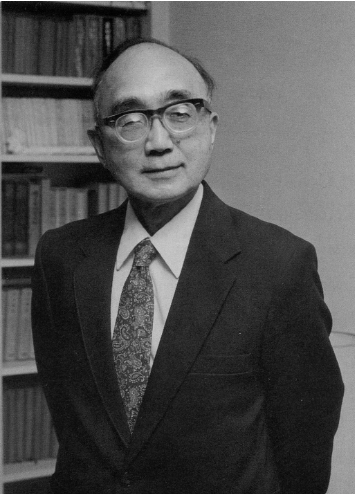
… today it is no exaggeration to say that Iwasawa’s ideas have played a pivotal role in many of the finest achievements of modern arithmetical algebraic geometry…
This thesis is primarily concerned with special values of \(L\)–functions and their congruence properties. The principal ingredient of the proof of our main result (Theorem 4.1) is Iwasawa’s construction of \(p\)-adic \(L\)–functions. As we mentioned in Chapter 1, the first evidence for the existence of a \(p\)-adic \(L\)–function was Kummer’s Congruences for special values of the Riemann Zeta function (Theorem A). Kummer, in fact, proved a stronger result: For a prime \(p\) and any two even positive integers \(m,n\) satisfying \(m\equiv n\not\equiv0\pmod{p-1}\) and \(m\equiv n\pmod{p^a(p-1)}\) for some \(a\geq0\text{,}\) then
Equation (3.1) takes the simple form \(\zeta(1-n)\equiv\zeta(1-m)\pmod{p}\) for \(a=0\text{.}\) Building on Kummer’s work, Kurt Hensel developed the theory of \(p\)-adic Numbers. In the world of \(p\)-adics, two integers are closer if their difference is divisible by a bigger power of \(p\text{.}\) This notion of distance makes the size of a prime \(p\) smaller than 1; we can apply our high school knowledge to compute the following infinite geometric series:
Equation (3.2) is the \(p\)-adic expansion of the \(p\)-adic number \((1-p)^{-1}\text{.}\) Let’s make this observation more rigorous. Fix a prime \(p\text{.}\)
Recall, as defined on page 18, \(v_p(n)\) denotes the maximum exponent \(e\) such that \(p^e\mid n\text{.}\) For a rational number \(x=m/n\) (\(n\neq 0\)), define \(v_p(x)\colonequals v_p(m)-v_p(n)\text{,}\) which extends the domain of \(v_p\) from \(\Z\) to \(\Q\) and the range from \(\Z_{\geq0}\) to \(\Z\text{.}\) Now, for any rational \(x\text{,}\) define
In particular, \(|p|_p=p^{-1}\lt 1\) which justifies the identity (3.2). This \(p\)-adic absolute value \(\abs{\cdot}_p\) defines a metric in \(\Q\) and the completion of \(\Q\) with respect to this metric is called \(\Q_p\text{;}\) the field of \(p\)-adic rational numbers. The subset [17, Definition 4.2.1]
is called the ring of \(p\)-adic integers – \(p\)-adic analogues of integers. Note that the cyclic subgroup of \(\Z_p\) generated by \(1\in\Z_p\) is isomorphic to \(\Z_p\text{.}\) It turns out that the image of \(\Z\) in \(\Z_p\) via the natural inclusion map \(\Z\hookrightarrow\Z_p\) is dense [17, Proposition 4.2.2]. Therefore, \(\Z_p\) is an example of a topologically cyclic group.
In 1918, Ostrowski proved his celebrated theorem [34, Chapter II, Theorem, 4.2] stating that these are essentially all the absolute values on \(\Q\) – one for each prime \(p\) and the Euclidean metric, which is surprising and shows the importance of Hensel’s work. For a prime \(p\text{,}\) the metric induced by \(\abs{\cdot}_p\) defines a metric topology on the completion \(\Q_p\text{.}\) We choose, once for all, an algebraic closure \(\overline{\Q}_p\) of \(\Q_p\text{.}\) It is well-known that \(\overline{\Q}_p\) is not complete [26, Chapter III, Theorem 12, p. 71] with respect to the unique extension [26, Chapter III, §3] of the absolute value \(\abs{\cdot}_p\) to \(\overline{\Q}_p\text{.}\) We use the notation \(\C_p\) to denote the completion of \(\overline{\Q}_p\) and it serves as a \(p\)-adic analogue of the complex numbers. There is a theory of \(p\)-adic analytic functions parallel to that of complex analytic functions. We all know the following two real-analytic functions with their corresponding power series
Unlike Euclidean topology, a power series \(\sum a_nx^n\) converges in the \(p\)-adic topology if and only if \(|a_nx^n|_p\to0\) as \(n\to\infty\)[26, Chapter III]. When \(|x|_p\lt 1\) for \(x\in\C_p\text{,}\) we have \(\abs{(-1)^{n-1}x^n/n}=|x|_p^np^{v_p(n)}\text{.}\) Since \(0\lt p^{v_p(n)}\leq n\text{;}\) hence \(0\lt |x|_p^np^{v_p(n)}\leq |x|_p^nn\text{,}\)\(|(-1)^{n-1}x^n/n|\to 0\) as \(n\to\infty\text{.}\) Therefore, we define the \(p\)-adic logarithm\(\log_p\) as the following power series
where the series (3.3) converges for all \(x\in\C_p\) such that \(|x|_p\lt 1\text{.}\) Similarly one can define the \(p\)-adic exponential\(\exp_p\) as the following power series
But, unlike the real exponential, the series (3.4) converges in a smaller open disc, i.e., for all \(x\in\C_p\) such that \(|x|_p\lt p^{-1/(p-1)}\lt 1\)[26, Chapter III, p. 79]. Moreover, \(\log_p\) and \(\exp_p\) are inverses of each other [26, Chapter III, Proposition in p. 81]. For more on \(p\)-adic analysis and \(p\)-adic numbers, we refer the readers to the classic texts [26, 43, 17, 47, 38].
Thus, a \(p\)-adic integer \(a\) has a unique representation via a sequence \(\{a_n\}_{n\geq1}\) of elements \(a_n\in\Z/p^n\Z\text{,}\) which is compatible in the sense that \(a_{n+1}\equiv a_n\pmod{p^{n}}\) for all \(n\geq1\)[17, Proposition 4.2.2]. Also, a \(p\)-adic integer \(a\) possess a unique \(p\)-adic expansion [17, Corollary 4.3.3]
for all \(m\geq2\text{.}\) The \(p\)-adic integers \(\Z_p\) is also the completion of the localization of \(\Z\) at the prime ideal \(p\Z\) and hence a Discrete Valuation Ring which is complete (complete DVR for short) [34, Chapter I, Proposition 11.5]. It is, therefore, a domain, and its field of fractions is \(\Q_p\text{.}\)
Now that we have introduced the \(p\)–adic absolute value, let’s revisit the congruence (3.1) and reinterpret in terms of \(\abs{\cdot}_p\text{.}\) For an odd prime \(p\) and any nonzero residue class \(k\in\Z/(p-1)\Z\text{,}\) let \((k)\) denote the set of integers which are \(k\pmod{p-1}\text{.}\) For any two integers \(m,n\text{,}\) observe that \(m\equiv n\pmod{p^a(p-1)}\) if and only if \(m,n\in(k)\) for some \(k\in\Z/(p-1)\Z\setminus\{0\}\) and
Write \(\Phi(n)=(1-p^{n-1})B_n/n\) for \(n\geq1\text{.}\) Therefore, as \(a\to\infty\text{,}\)i.e., as \(m\) and \(n\) get closer and closer in the \(p\)–adic world, so does \(\Phi(m)\) and \(\Phi(n)\text{,}\) provided that \(m,n\) belong to the same nonzero congruence class in \(\Z/(p-1)\Z\text{.}\) We are almost close to saying that \(\Phi\) is continuous in \(\Z\) with respect to the \(p\)-adic topology! To be precise, Kummer’s Congruences (3.1) are equivalent to the following statement: Let \(\{x_n\}_{n\geq1}\) be a Cauchy sequence in \((k)\text{,}\) for some \(k\in(\Z/(p-1)\Z)\setminus\{0\}\text{,}\)(i.e.,\(x_n\in(k)\) for all \(n\geq1\) and for any given \(\varepsilon\gt 0\text{,}\) there exists \(N=N(\varepsilon)\geq1\) such that \(|x_m-x_n|_p\lt \varepsilon\) for all \(m,n\geq N\)). Then \(\{\Phi(x_n)\}_{n\geq1}\) is also a Cauchy sequence. Recall that \(\Z\hookrightarrow\Z_p\) is dense. Therefore, it makes sense to interpolate (see [36, Chapter 5] for an exposition of \(p\)-adic interpolation) the values of \(\Phi\) to create a \(p\)-adic analytic function on \(\Z_p\text{.}\) In 1964, Tomio Kubota and Heinrich-Wolfgang Leopoldt gave the first construction of a \(p\)-adic Riemann Zeta function, denoted \(\zeta_p\text{,}\) by \(p\)-adically interpolating the special values of \(\zeta\) at negative odd integers and using Kummer’s congruences. To be precise, they constructed \(p\)–adic analogues of Dirichlet \(L\)–functions, denoted \(L_p(s,\chi)\) satisfying the interpolation formula [47, Theorem 5.11]
Due to the necessity of the condition \(m\equiv n\pmod{p-1}\) in Kummer’s congruences, there is no unique \(p\)–adic \(L\)–function that interpolates \(L(1-n,\chi)\) for all positive integers \(n\text{.}\) Rather, there are \(p-1\) of them, one corresponding to each congruence class modulo \(p-1\text{.}\) Motivated by an alternate approach toward complex \(L\)-functions, first developed by John Tate in his famous 1950 Ph.D. Thesis [45] and later independently by Iwasawa [20], \(p\)–adic \(L\)–functions may be realized as \(\Z_p\)–valued measures (to be precise, the elements of the Iwasawa Algebra \(\Lambda(\Z_p)\text{,}\) defined later in this Chapter, may be identified with \(p\)–adic measures [47, Chapter 12]). This approach allows us to encode information about \(p\)–adic \(L\)–functions for all Dirichlet characters in just one object, which justifies the notations \(L_p(s,\chi)\) as we can regard \(p\)–adic \(L\)–functions as functions on characters. However, this thesis mainly concerns the algebraic construction, partly motivated by the Weil Conjectures.
In 1969, Kenkichi Iwasawa published his seminal paper [23], which demonstrated a new approach to \(p\)-adic \(L\)–functions through his studies on the structure of Galois modules (especially Class Group) over towers of cyclotomic extensions. The study of this theme was motivated by the Weil Conjectures[14] and was, perhaps, first predicted by André Weil himself in his 1942 letter [48, pp. 280–298] to Emil Artin, where he writes:
“… when one looks for a possibility of extending our theory to number-fields, one meets at the outset of the following difficulty. Our proof for the Riemann hypothesis depended upon the extension of the function fields by roots of unity, i.e., by constants; the way in which the Galois group of such extensions operates on the classes of divisors in the original field and its extensions gives a linear operator, the characteristic roots (i.e. eigenvalues) of which are the roots of the zeta-function. On a number field, the nearest we can get to this is by adjunctions of \(\ell^n\)-th roots of unity 1
Note that unlike modern articles, \(\ell\) does not denote a prime
, \(\ell\) being fixed; the Galois group of this infinite extension cyclically defines a linear operator on the projective limit of (absolute) class groups of those successive finite extensions; this should have something to do with the roots of the zeta-function in the field. However, our extensions here are ramified (but only at a finite number of places, namely prime divisors of \(\ell\)). Thus, a preliminary study of similar problems in function fields might enable one to guess what will happen in number fields.”
Iwasawa’s groundbreaking discoveries, starting in the late 1950s, have now culminated in a rich mathematical theory known as Iwasawa Theory, whose goal is to seek analogues of techniques, used for varieties defined over function fields, pioneered by Hasse, Weil, Deligne, Dwork, Grothendieck, and other experts, for varieties defined over number fields.
Due to the limited scope of this thesis, we are unable to include technical details of Iwasawa’s work, except for a brief description of his construction of \(p\)–adic Dirichlet \(L\)–functions in the sections to follow. For a detailed exposition, we refer to the excellent monograph [8].